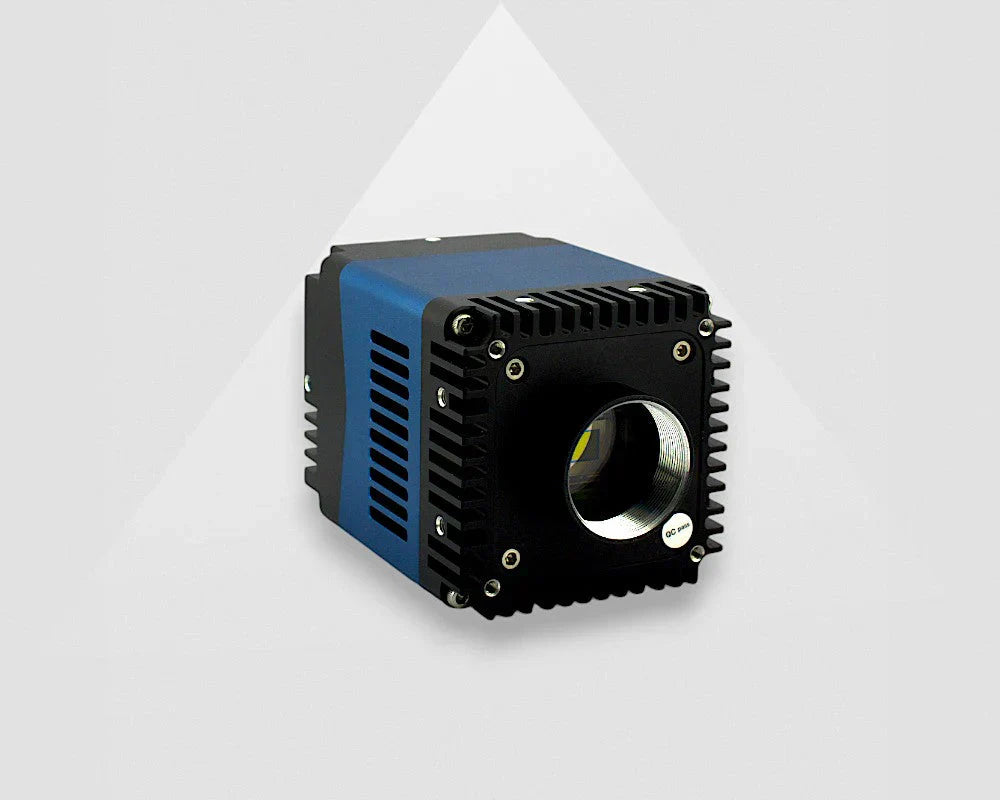


De quelles technologies de caméras 3D ai-je besoin ?
 Gaspar van Elmbt
Dans le monde de l’automatisation industrielle et de la vision industrielle, le choix des équipements d’imagerie est essentiel. Une caméra 3D (ou caméra de profondeur) offre bien plus d’informations qu’une image 2D conventionnelle : elle fournit des données sur la géométrie, la position spatiale et la forme de la surface.

Si vous spécifiez une caméra industrielle pour un système de vision industrielle, il est important de comprendre quelle technologie de caméra 3D convient à votre application. Cet article retrace l’historique des technologies de caméra 3D, compare les principaux types et vous aide à décider quelle méthode convient à votre solution de vision industrielle.
Tables des matières
Historique des technologies de caméras 3D en Vision industrielle
Les origines de la vision industrielle remontent à plusieurs décennies, évoluant de simples systèmes d’inspection 2D vers une détection de profondeur 3D sophistiquée. Le terme « vision industrielle » désigne l’inspection automatisée basée sur l’imagerie, le guidage robotisé et le contrôle de processus dans l’industrie.
En parallèle, des méthodes d’imagerie 3D ont commencé à être appliquées dans l’industrie ; des scanners laser 3D précoces existaient dans les années 1960, principalement à titre expérimental pour le profilage de surface. Au fil du temps, à mesure que les capteurs et le traitement s’amélioraient, la vision 3D est devenue viable pour les applications de caméra industrielle et de vision industrielle.
Par exemple, des technologies 3D telles que la numérisation par lumière structurée, la vision stéréo et le time-of-flight (ToF) ont émergé et ont progressivement mûri. À mesure que les équipements devenaient plus robustes pour les ateliers de production et les robots, l’appellation « caméra industrielle » s’est étendue aux caméras 3D (plutôt qu’uniquement 2D).
Aujourd’hui, lors de la spécification d’une caméra industrielle 3D pour des tâches de vision industrielle, telles que l’inspection, le guidage robotisé, le tri, etc., vous devez connaître les points forts et les limites de chaque technologie sous-jacente.

Comparaison des principales technologies de Caméra 3D
Voici un tableau comparatif des technologies de caméras 3D les plus courantes utilisées dans des contextes de vision industrielle / caméras industrielles.
| Technologie de caméras 3D | Principe | Atouts typiques d'Application | Limitations |
|---|---|---|---|
|
Stereo Vision |
Deux caméras ou plus capturent des images depuis différents points de vue ; la profondeur est calculée par triangulation des caractéristiques correspondantes. |
Passif (sans projection active), adapté aux scénarios avec lumière ambiante, coût inférieur ; utile pour le pick and place, le guidage robot lorsque la texture est présente. |
Nécessite une bonne texture ou des caractéristiques pour l’appariement ; la qualité diminue sur des surfaces à faible contraste, spéculaires, transparentes ; sensible à l’étalonnage. |
|
Lumière structurée (projection de franges) |
Un motif lumineux connu (bandes, grille) est projeté sur l’objet ; la déformation du motif est capturée par des caméras et utilisée pour calculer la profondeur. |
Haute précision, bonne résolution, souvent utilisée pour des pièces de petite à moyenne taille, inspection, métrologie. |
Peut être sensible à la lumière ambiante ou aux surfaces réfléchissantes ; distance de projection limitée ; plus lent (nécessite plusieurs motifs), sauf en version haute vitesse. |
|
Time-of-Flight (ToF) |
Measures the time taken for a light pulse to travel to the object and back; direct depth measurement per pixel. |
Single-shot depth capture, good for larger volumes, dynamic scenes (robotics, logistics, bin picking). |
Résolution en profondeur moins élevée que la lumière structurée ; problèmes de trajets multiples/de réflexion ; résolution spatiale parfois plus faible ; interférences IR ambiantes. |
|
Balayage laser/ Rideau lumineux/ Triangulation laser |
Une ligne laser ou un rideau lumineux balaie l’objet ; la caméra observe la déformation ou le déplacement de la ligne laser réfléchie afin de calculer la profondeur. |
Très haute précision pour la mesure de profil, longues distances de mesure, adapté aux grandes pièces ou surfaces. |
Souvent un balayage mécanique est impliqué, plus lent pour une 3D complète, nécessite un mouvement relatif de la caméra et de l’objet d’intérêt ; coût plus élevé ; moins adapté à la capture d’une scène complète à grande vitesse. |
Quelle technologie vous faut-il pour votre tâche de Vision industrielle ?
Lorsque vous décidez « quelle technologie de caméra 3D me faut-il ? », tenez compte des critères suivants :
Distance de travail/ champ de vision : Visez-vous une application de bin picking avec un grand volume, ou une tâche d’inspection fine de petites pièces ?
- Pour une résolution très fine à courte distance : la lumière structurée est souvent idéale.
- Pour de grands volumes, une prise dynamique ou un champ plus large : ToF ou la stéréo vision peuvent mieux convenir.
Vitesse/Scènes dynamiques : Avez-vous besoin d’une capture en une seule prise (objets en mouvement, bras robotisés) ?
- ToF permet une capture de profondeur plus rapide (par image) que de nombreux systèmes à lumière structurée multipattern.
Précision/Résolution : Une haute précision (microns) est-elle requise ?
- La lumière structurée ou la triangulation laser excellent en précision : la stéréo vision/Time-of-Flight peuvent échanger de la résolution contre de la vitesse/du volume.
Éclairage ambiant/Environnement : L’installation se fait-elle sous éclairage contrôlé ou en atelier avec un éclairage variable ?
- Les systèmes de projection (lumière structurée) peuvent être affectés par l’éclairage ambiant ; la stéréo vision et Time-of-Flight peuvent être plus robustes en conditions d’éclairage difficiles.
Budget/Complexité d’intégration : Les systèmes de stéréo vision plus simples peuvent coûter moins cher ; la lumière structurée et les systèmes laser peuvent nécessiter davantage d’étalonnage et de configuration.
Recommandations générales approximatives
- If your machine vision task is quality inspection of small parts and you need high accuracy, go for structured-light 3D camera.
- If you are doing robotic pick & place, logistics, bin picking, where objects move and you need speed and volume, consider ToF or a hybrid system.
- If you have a scenario with good texture, moderate volume, and you want a lower-cost solution, stereo vision might suffice.
- For large surfaces, profiles, or traditional metrology in manufacture, laser scanning/ triangulation remains relevant.
The underlying technology matters: stereo vision, structured light, Time-of-Flight, laser triangulation each bring distinct trade-offs. When specifying an industrial camera for machine vision, ask: what is the working volume, what is the surface of interest, what precision is required, how fast does the system need to act, and under what lighting/ environmental conditions?
By aligning your application with the correct 3D camera technology, you ensure better performance, lower integration risk, and a more reliable machine-vision solution.
Réflexions finales sur le choix de la bonne technologie de caméra 3D
Chaque technologie de caméra 3D a sa place dans le paysage industriel. Les systèmes à lumière structurée excellent en précision ; les caméras ToF gèrent les scènes dynamiques avec aisance ; la vision stéréo est abordable et flexible ; et la triangulation laser reste la solution de référence pour les mesures de haute précision.
Lorsqu’elle est mise en œuvre correctement, une caméra 3D peut améliorer votre système de vision industrielle, en offrant une automatisation supérieure, une réduction des temps d’arrêt et des données fiables pour le contrôle des processus.
FAQ'S
Choisir la bonne caméra 3D pour votre application de vision industrielle peut être difficile, mais vous n’avez pas à décider seul.
Contacter VA Imaging
Contactez nos experts dès aujourd’hui pour discuter des exigences de votre projet. Nous vous aiderons à identifier la technologie de caméra 3D optimale et vous accompagnerons tout au long de l’intégration, de l’étalonnage et de la configuration du système afin de garantir la plus haute précision et les meilleures performances pour votre application industrielle.
Prenez contact via le formulaire ci-dessous pour commencer à construire votre système vision de nouvelle génération.