
Select SWIR lenses for industrial inspection, material analysis and scientific imaging in the United Kingdom. VA Imaging supplies fixed focal length C-mount lenses for 400–1700 nm Visible+SWIR systems and dedicated 900–1700 nm SWIR systems, with options for sensors up to 1″ and focal lengths from 8 mm to 50 mm.
Compare the products below by spectral range, sensor format, resolution, pixel size, focal length and aperture. VA Imaging provides selection, compatibility, pricing, availability and documentation support for machine builders, system integrators, OEMs, manufacturers and research teams throughout the UK.
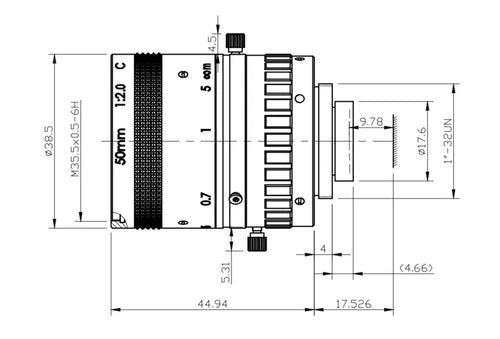
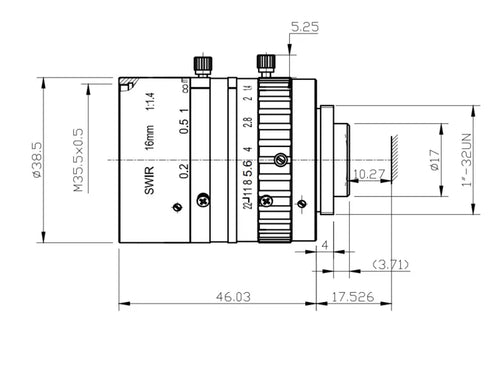
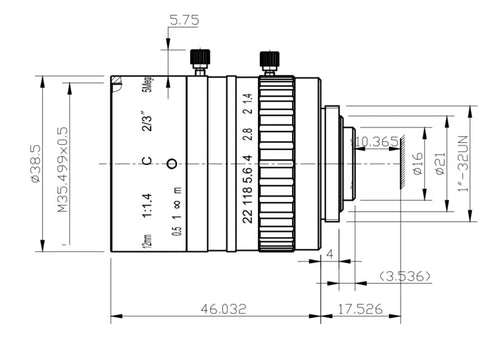
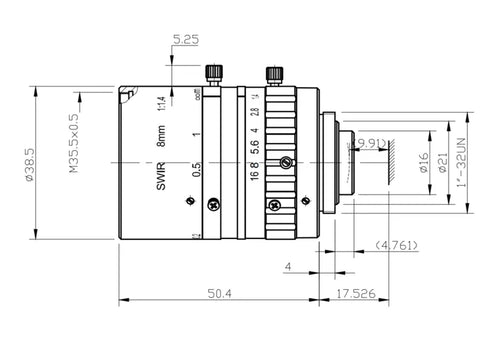
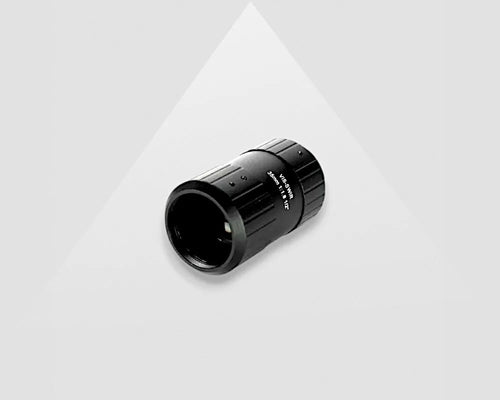
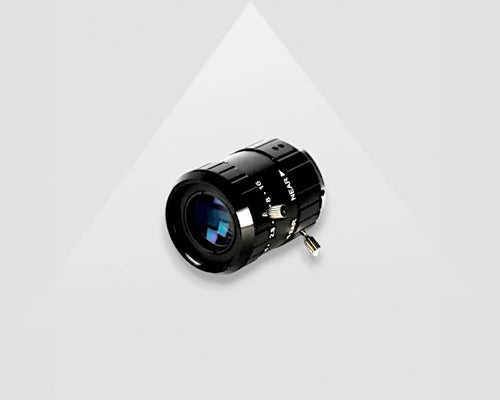
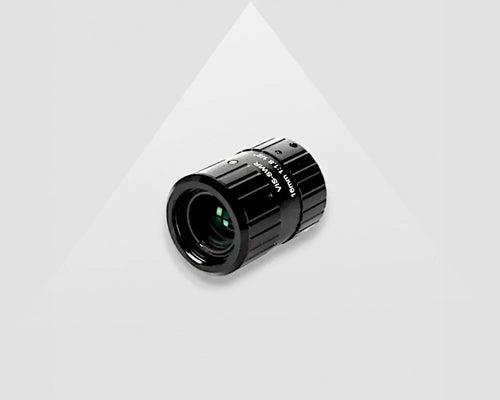
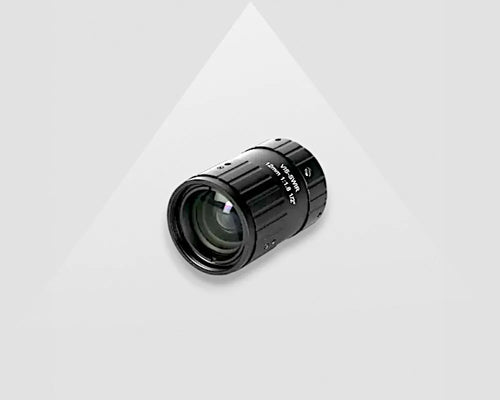
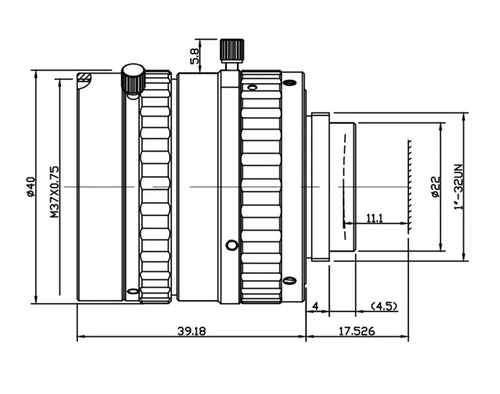
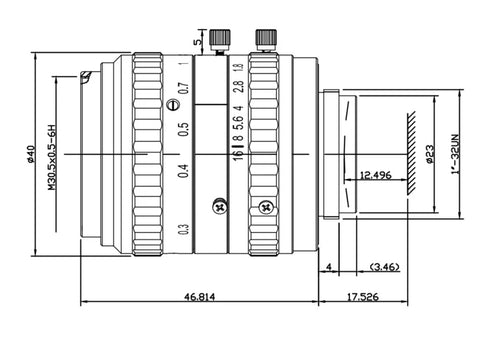
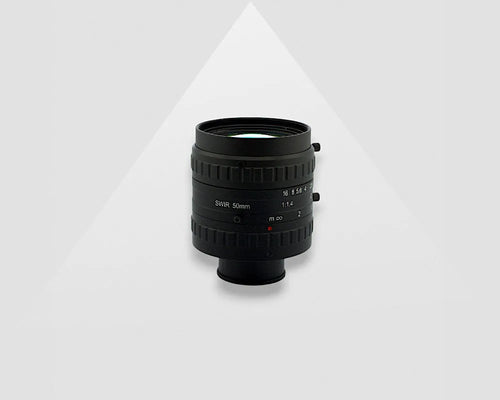
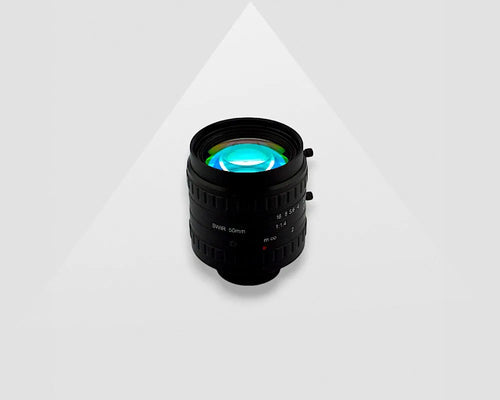
Start by matching the lens series to the camera sensor and wavelengths used in the inspection. The table below summarises the three fixed focal length C-mount SWIR lens families available from VA Imaging.
| Lens series | Spectral range | Maximum sensor format | Resolution class | Recommended camera pixel size | Available focal lengths | Sensor match noted on product pages |
|---|---|---|---|---|---|---|
| 1.3 MP Visible+SWIR | 400–1700 nm | 1/2″ | 1.3 MP | 3.45 µm or larger | 12, 16, 25 and 35 mm | Sony IMX990 and IMX991 |
| 2 MP SWIR | 900–1700 nm | 2/3″ | 2 MP | 3.45 µm or larger | 8, 12, 16, 25 and 50 mm | Sony IMX990 |
| 5 MP SWIR | 900–1700 nm | 1″ | 5 MP | 3.45 µm or larger | 25, 35 and 50 mm | Sony IMX992 and IMX993 |
All models use C-mount. The listed sensor matches are taken from the relevant product information and are intended as an initial guide. Confirm the exact camera model, active sensor dimensions, cover glass and spectral response before choosing a lens.
Browse the wider range of C-mount lenses for industrial cameras when comparing SWIR optics with other machine vision lens types.
A SWIR lens transmits and focuses shortwave infrared radiation onto a compatible camera sensor. Materials reflect, absorb or transmit SWIR wavelengths differently, allowing an imaging system to reveal features that may have little contrast under visible illumination.
Many industrial InGaAs cameras operate across approximately 900–1700 nm. Visible+SWIR systems extend into the visible spectrum and can cover approximately 400–1700 nm. The lens must support the operating band, but spectral range alone does not guarantee a useful result. The illumination wavelength, filter, material, sensor response, exposure and image-processing method must work together.
SWIR imaging should also be distinguished from thermal imaging. SWIR systems generally form images from reflected or transmitted light, whereas thermal systems normally detect longer-wave radiation emitted in relation to an object’s temperature.
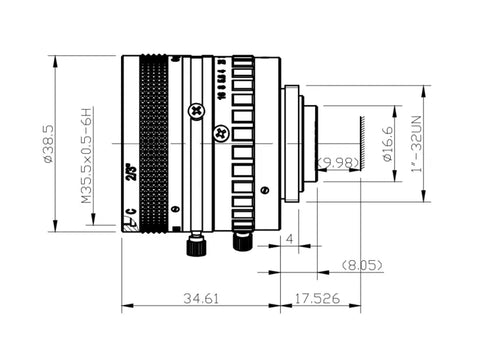
Compare the optical and mechanical specifications of the exact model rather than selecting a lens based on focal length alone. Product filters and technical documents can help narrow the available options.
Important specifications include:
The nominal sensor format—such as 1/2″, 2/3″ or 1″—is useful for comparison, but field-of-view calculations should use the camera’s actual sensor width and height. Use the machine vision lens calculator for an initial estimate, then verify the result using the selected camera and a representative sample.
Dedicated SWIR and Visible+SWIR lenses serve different imaging strategies. Select the narrower SWIR-only range when visible imaging is unnecessary, or choose Visible+SWIR optics when the same system must operate in both spectral regions.
| Lens type | Range represented in this collection | Appropriate when | Check before selection |
|---|---|---|---|
| Dedicated SWIR | Approximately 900–1700 nm | The application uses SWIR illumination and a SWIR-sensitive camera | Transmission and image quality at the exact operating wavelength |
| Visible+SWIR | Approximately 400–1700 nm | One system must collect both visible and SWIR images | Focus stability and contrast across all wavelengths used |
The wider spectral range can simplify a multi-band system, but it does not remove the need to validate focus, exposure and optical performance in each band.
Focus shift can occur when a system changes between visible and SWIR wavelengths. Optical materials refract wavelengths differently, which can move the best-focus position even when the camera, lens and object remain fixed.
For an application that alternates between visible and SWIR illumination, focus the system at each operating wavelength during testing. Check both the centre and edges of the image and use the intended aperture, working distance and filter.
If the shift exceeds the permitted tolerance, the system may require a Visible+SWIR lens designed for the complete band, a focus adjustment between captures, a smaller aperture where exposure permits or separate calibrated imaging positions.
Do not assume that a lens transmitting the full wavelength range is automatically corrected to the same focus throughout that range. The required level of correction depends on feature size and measurement tolerance.
SWIR illumination must provide sufficient energy at the wavelength where the target produces useful contrast. A suitable lens and camera cannot compensate for a light source with inadequate output in the required band.
Possible illumination approaches include:
Ambient illumination is often inconsistent, particularly when an inspection must produce repeatable measurements. A bandpass or longpass filter can reduce unwanted wavelengths, but its transmission range, blocking performance and thread size must match the optical system.
Compare machine vision lighting and bandpass and longpass lens filters, then confirm that the selected products support the target SWIR wavelength.
SWIR lenses can support automated inspection and scientific imaging when shortwave infrared reveals information that a conventional visible camera cannot capture reliably.
Typical applications include:
These are potential application areas rather than guaranteed results. Test representative samples at the intended wavelength and production speed before defining the final system.
I am absolutely thrilled with the MER2-160-227U3M camera I purchased from VA-Imaging. The camera exceeds my expectations in every way. The image quality is sharp and clear, even with fast movements. Installation was straightforward. VA-Imaging's customer service was also outstanding. They were very helpful in answering my questions and delivered the camera quickly and securely.
The cameras are a great value for money and the lenses also. The software is outdated and needs refreshing. It took me considerable amount of time to discover how to access the camera features.
Its a pleasure to contact with the sales department. They are very polite and always ready to help. Our orders are always delivered on time and the communication is easy and simple. High quality products.
We initially explored several embedded vision camera and USB3 camera options for our application. Our main priorities were compact dimensions and keeping the required software development to a minimum. We selected a VEN-161 boardlevel camera. It was easy to integrate and USB3 Vision interface allowed our software team to get started quickly. The sales guy was very helpful with selecting the hardware for us. We are happy that we selected the USB3 board-level camera instead of a Mipi embedded vision camera as we didn't require now the additional driver development.
It was easy and quick process from ordering to receiving. One personal message from the team is making it even better. Thanks
In the commercial phase we had maximum support and delivery times were respected. The material is quite good with low and competitive costs.
Most common questions are already answered on our FAQ page. Questions about delivery times, warranty, loan, returns, longevity, manuals etc.
Image processing software captures the images from an industrial camera and performs complex image processing tasks like segmentation, detection, code and text reading.
We share our machine vision knowledge in our knowledge center. Find tutorials how to connect cameras, install software & program I/O.
Check how our customers use our industrial cameras, lenses and lighting in their application
Ask our machine vision experts! We answer rapidly and think along with your imaging project.
The download page provides access to product documentation, software, drivers, manuals and technical resources for industrial cameras and machine vision components.