


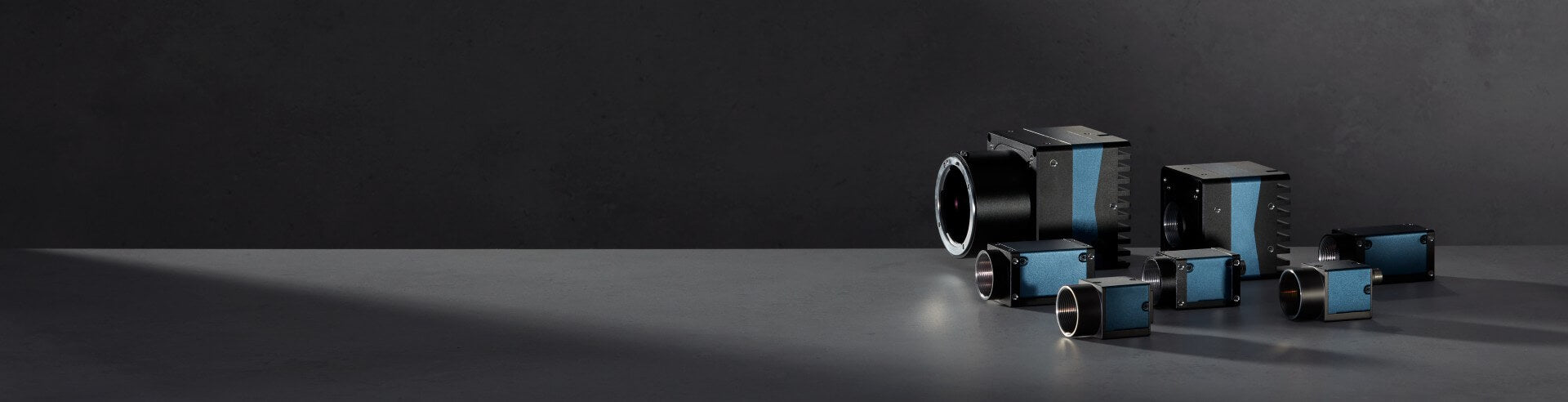
Choose an area scan camera for industrial inspection, measurement, barcode reading, robotic guidance and quality control in Canada. This collection includes machine vision cameras with different resolutions, frame rates, sensor formats, shutter technologies and industrial interfaces.
Compare colour and monochrome models, global and rolling shutter cameras, and connectivity options such as USB3 Vision, GigE Vision, high-speed GigE and CoaXPress. Use the collection filters to narrow the available products, or contact VA Imaging for help matching the camera with a suitable lens, lighting arrangement and processing platform.


Start with the main requirement of your application:
The correct camera cannot be selected from one specification alone. Resolution, exposure, shutter type, optics, lighting, interface bandwidth and processing capacity must work together.
Depending on the selected model, cameras in this collection may offer:
Available specifications vary by product. Review the individual camera information or ask VA Imaging to identify models that meet a particular technical requirement.
An area scan camera uses a two-dimensional sensor to capture the complete field of view in a single image. Machine vision software can then inspect, locate, identify or measure the objects within that image.
Area scan imaging is well suited to discrete products, packages, components and defined workspaces.
Typical tasks include:
An area scan camera is generally the most direct choice when the complete object or inspection area can be viewed in one or several image frames.
Begin by defining what the machine vision system must detect, inspect or measure. The following application details can help narrow the available options:
These factors influence the required resolution, shutter technology, frame rate, interface and lens.
The camera needs enough resolution to clearly show the smallest feature, defect or marking in the inspection area.
As a simple rule, a larger field of view or a smaller feature will require more pixels. For example, inspecting a wide product while detecting very small details may require a higher-resolution area scan camera.
Extra resolution can be useful, but more is not always better. It can increase image size, processing time, bandwidth requirements and lens cost. The aim is to choose enough resolution for reliable inspection without unnecessarily increasing system complexity.
Shutter technology affects how the camera captures movement.
A global shutter area scan camera exposes the complete sensor at the same time. It is normally preferred for:
A rolling shutter area scan camera exposes the sensor rows one after another. It may be suitable for:
A global shutter helps preserve the shape of moving objects, but exposure time and lighting must still be controlled to reduce motion blur.
The interface transfers image data from the camera to the processing computer. It also affects cable distance, host hardware and multi-camera integration.
| Interface | Suitable For | Main Consideration |
|---|---|---|
| USB3 Vision | Compact machines with nearby processing | Cable distance and controller capacity |
| GigE Vision | Distributed systems and longer cable routes | Network bandwidth and configuration |
| 2.5GigE, 5GigE and 10GigE | Higher-resolution or faster Ethernet imaging | Compatible network hardware |
| CoaXPress | High-throughput industrial acquisition | Frame grabber and host architecture |
A monochrome area scan camera is often preferred when the inspection depends on shape, edge position, brightness or fine surface detail. Monochrome imaging can also provide strong contrast for measurement and defect detection.
A colour area scan camera is more suitable when colour contributes directly to the inspection decision. Typical applications include:
Choose colour when it provides useful inspection information. It creates more image data and generally requires consistent lighting for repeatable results.
Some applications require imaging outside the standard visible spectrum. Depending on the available range, specialist options may include:
These technologies can reveal contrast or material differences that may not be visible to a standard camera. The lens, lighting, filters and protective windows must also be suitable for the selected wavelength.
An area scan camera captures a complete image frame. A line scan camera records one or more rows of pixels and builds the image as the product moves.
| Selection Factor | Area Scan Camera | Line Scan Camera |
|---|---|---|
| Image acquisition | Captures a complete frame | Builds an image line by line |
| Product type | Discrete products and defined scenes | Continuous or elongated materials |
| Triggering | Frame-based | Often synchronized with an encoder |
| Typical uses | Robotics, OCR, assembly and measurement | Paper, film, textiles, timber and web inspection |
The lens must cover the camera sensor and provide enough optical detail for the inspection. Important lens factors include:
Lighting should create clear contrast around the feature being inspected. Common arrangements include:
The camera, lens and lighting should be tested together using representative production samples.
Area scan cameras can inspect labels, closures, printed codes, parcel orientation and package condition. Global shutter models and controlled lighting are often required on moving conveyors.
High-resolution cameras can inspect component placement, connectors, printed markings and assembly details. Monochrome imaging is often suitable when contrast and edge accuracy matter more than colour.
An area scan camera can provide position and orientation data for pick-and-place systems, machine loading and automated handling. Calibrated optics and stable mounting can also support dimensional inspection.
Area scan imaging can check labels, caps, seals and package presentation. Diffuse or polarized lighting may be needed to manage reflections from glass, metal or flexible packaging.
Selecting an area scan camera involves more than comparing megapixels and frame rate. Shutter type, sensor format, interface bandwidth, lens performance, lighting and installation conditions all influence image quality and system reliability.
Use the filters in this collection to compare suitable models. Contact VA Imaging for help selecting a compatible area scan camera, lens and lighting configuration for your Canadian machine vision application.
Contact VA ImagingI am absolutely thrilled with the MER2-160-227U3M camera I purchased from VA-Imaging. The camera exceeds my expectations in every way. The image quality is sharp and clear, even with fast movements. Installation was straightforward. VA-Imaging's customer service was also outstanding. They were very helpful in answering my questions and delivered the camera quickly and securely.
The cameras are a great value for money and the lenses also. The software is outdated and needs refreshing. It took me considerable amount of time to discover how to access the camera features.
Its a pleasure to contact with the sales department. They are very polite and always ready to help. Our orders are always delivered on time and the communication is easy and simple. High quality products.
We initially explored several embedded vision camera and USB3 camera options for our application. Our main priorities were compact dimensions and keeping the required software development to a minimum. We selected a VEN-161 boardlevel camera. It was easy to integrate and USB3 Vision interface allowed our software team to get started quickly. The sales guy was very helpful with selecting the hardware for us. We are happy that we selected the USB3 board-level camera instead of a Mipi embedded vision camera as we didn't require now the additional driver development.
It was easy and quick process from ordering to receiving. One personal message from the team is making it even better. Thanks
In the commercial phase we had maximum support and delivery times were respected. The material is quite good with low and competitive costs.
Most common questions are already answered on our FAQ page. Questions about delivery times, warranty, loan, returns, longevity, manuals etc.
Image processing software captures the images from an industrial camera and performs complex image processing tasks like segmentation, detection, code and text reading.
We share our machine vision knowledge in our knowledge center. Find tutorials how to connect cameras, install software & program I/O.
Check how our customers use our industrial cameras, lenses and lighting in their application
Ask our machine vision experts! We answer rapidly and think along with your imaging project.
The download page provides access to product documentation, software, drivers, manuals and technical resources for industrial cameras and machine vision components.