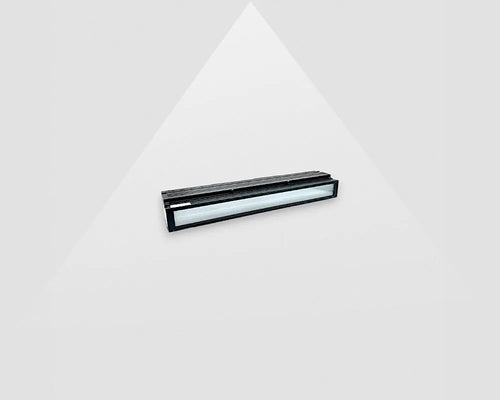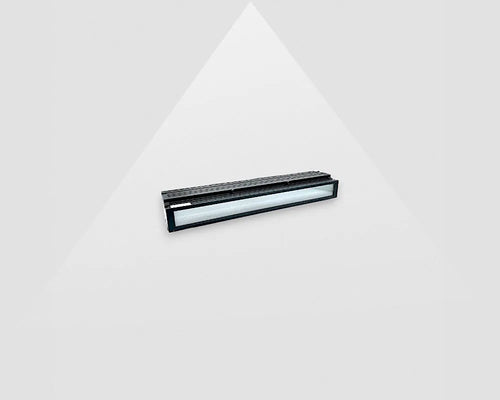
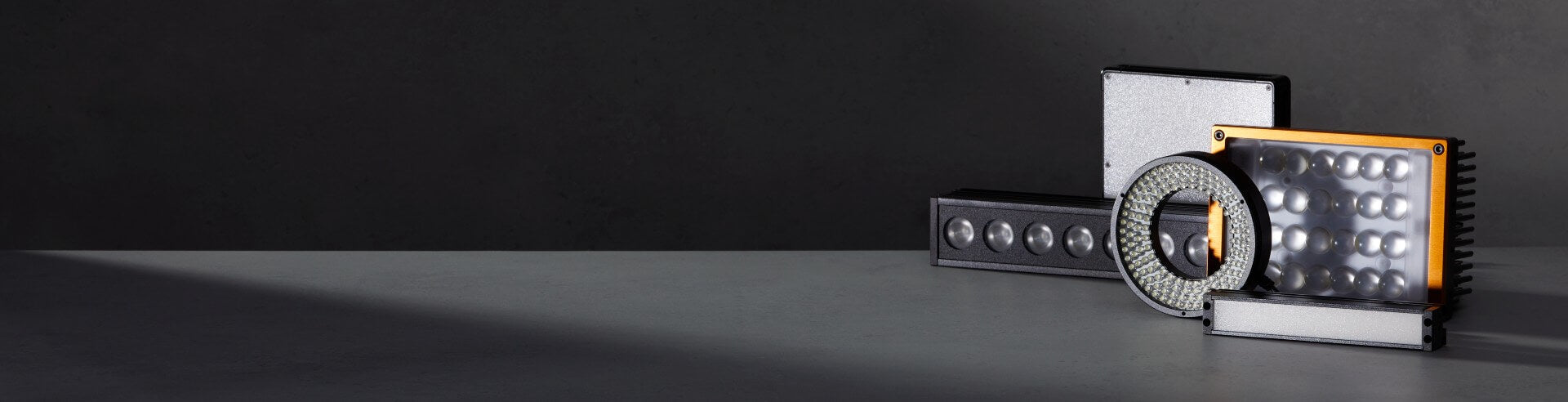
Line scan lights provide focused illumination for machine vision systems inspecting moving products, continuous materials and long objects. They are commonly paired with line scan cameras, which build a complete image from individual lines captured as the product moves through the inspection area.
VA Imaging supplies line scan lighting for machine vision applications across Canada, including web inspection, conveyor inspection, foil and film inspection, surface defect detection, print inspection, glass inspection and electronics production.
The VA line light range includes standard and high-brightness models with emitting lengths from 100 to 1500 mm. Selecting the right light depends on the inspection width, production speed, exposure time, working distance, surface properties and the contrast required for reliable image processing.
Line scan lighting is particularly useful when products or materials move continuously through an automated inspection system.
Instead of capturing a complete two-dimensional image in one exposure, a line scan camera records a narrow line repeatedly as the material moves. These lines are combined to create the complete image.
This makes line scan systems well suited to:
The lighting needs to remain consistent throughout this process so changes in illumination are not mistaken for changes in the inspected product.
VA Imaging offers two line light series for different machine vision requirements.
| Specification | VA-LLS5 Standard Line Light | VA-LLHB2 High-Brightness Line Light |
|---|---|---|
| Type | Standard line light | High-brightness line light |
| Emitting length | 100–1500 mm | 100–1500 mm |
| Emitting width | 25 mm | 25 mm |
| Power range | 29–432 W* | 52–750 W* |
| Cable configuration | 4 or 6 poles* | 4 or 6 poles* |
| Supply | Current-controlled 48 V | Current-controlled 48 V |
| Typical use | General continuous inspection | Applications requiring greater illumination intensity |
*Depending on the selected model.
The VA-LLS5 is suited to general line scan inspection where stable illumination is required across the inspection width.
The VA-LLHB2 provides greater light output and can be useful when higher line rates, short exposure times or demanding surface conditions increase the required illumination intensity.
Several factors determine whether a line light will provide suitable illumination for the application.
The illuminated area should cover the complete field of view of the line scan camera.
If the light does not provide sufficient coverage across the inspection width, the edges of the final image may appear darker. The emitting length should therefore be selected together with the field of view and mounting position.
VA-LLS5 and VA-LLHB2 models are available with emitting lengths from 100 to 1500 mm.
Production speed influences how quickly the camera needs to acquire successive image lines.
As the line rate increases, the available exposure time can decrease. The lighting must provide sufficient intensity during this shorter exposure period for the camera to capture usable image information.
Higher-speed applications may therefore require a high-brightness line light.
Working distance affects both light intensity and illumination coverage.
Increasing the distance between the line light and the object changes the amount of light reaching the surface and can also alter the illuminated area.
The working distance should be evaluated together with the camera position, field of view and available installation space.
Different materials interact with illumination differently.
Reflective metal, transparent film, glass, matte plastic and textured materials can all require different lighting positions or wavelengths.
The best configuration depends on which feature the inspection system needs to make visible.
The objective of machine vision lighting is to create useful contrast.
Increasing brightness alone does not always make an inspection more reliable. In some applications, changing the illumination angle or wavelength can produce a much clearer difference between the required feature and its surroundings.
Line scan systems require consistent lighting across both space and time.
Spatial uniformity refers to how evenly the illumination covers the inspection area.
Poor alignment, an unsuitable working distance or insufficient light length can create brightness differences across the final image.
Temporal stability refers to how consistently the light performs as the camera captures successive lines.
Variations in light output can appear as repeated bright or dark bands in the finished image. Stable illumination and the correct power supply therefore contribute directly to repeatable inspection results.
The wavelength of the illumination can affect how clearly features appear in the image.
White light is suitable for many general industrial inspection applications. In other situations, a specific visible or non-visible wavelength can provide better separation between the feature being inspected and the surrounding material.
Depending on the application and configuration, Red, Green, Blue, UV and IR options are available on request.
Consider wavelength when:
The camera sensor also needs to be sensitive to the selected wavelength.
The line light needs to be matched to the electrical requirements of the inspection system.
VA-LLS5 and VA-LLHB2 line lights operate with a stable, current-controlled 48 V supply. A compatible VA-PS4-CD power supply should be selected according to the power requirement of the chosen model.
Depending on the model size and power, either a 4-pole or 6-pole cable connection is required.
Before installation, check:
Checking these requirements early makes it easier to integrate the light into the complete machine vision system.
The most useful starting point is to define the application rather than selecting a light based only on dimensions.
| Application detail | Why it matters |
|---|---|
| Inspection width | Determines the required emitting length |
| Working distance | Influences intensity and coverage |
| Camera model | Helps determine imaging requirements |
| Production speed | Influences line rate and exposure |
| Exposure time | Affects the required light intensity |
| Material | Influences reflection and transmission |
| Surface finish | Helps determine lighting angle |
| Feature to detect | Defines the required contrast |
| Wavelength | Can improve feature separation |
| Mounting space | Influences the possible lighting geometry |
Check the exposure time, working distance and available illumination intensity. A high-brightness line light may be required when the exposure period becomes very short.
Check the light alignment, emitting length and working distance to confirm that the complete field of view receives consistent illumination.
Bright or dark bands can indicate variations in illumination between successive image lines. Check lighting stability and the power supply.
Adjust the lighting position or angle. Reflective surfaces may require a different geometry to prevent direct reflections from dominating the image.
More intensity may not solve the problem. Consider changing the wavelength, lighting angle or exposure settings to improve feature separation.
VA Imaging offers the VA-LLS5 and VA-LLHB2 series in standard emitting lengths from 100 to 1500 mm.
When a standard configuration does not match the application, specific requirements can be discussed based on the inspection width, working distance, wavelength and required illumination level.
Useful information to provide includes:
This makes it possible to evaluate the lighting as part of the complete imaging system rather than as an individual component.
VA Imaging supports manufacturers, machine builders, OEMs and system integrators with machine vision projects across Canada.
Our team can help evaluate line scan lighting together with the camera, lens, inspection width, working distance and production requirements.
Support can include comparing standard and high-brightness illumination, evaluating wavelength options and determining the information required for a new or existing continuous inspection system.
A reliable line scan system depends on the camera and illumination working together under real operating conditions.
Share your camera model, inspection width, working distance, production speed, material and inspection objective with VA Imaging. Our machine vision team can help evaluate the most suitable line scan lighting configuration for your application in Canada.
Ask Our Machine Vision ExpertsI am absolutely thrilled with the MER2-160-227U3M camera I purchased from VA-Imaging. The camera exceeds my expectations in every way. The image quality is sharp and clear, even with fast movements. Installation was straightforward. VA-Imaging's customer service was also outstanding. They were very helpful in answering my questions and delivered the camera quickly and securely.
The cameras are a great value for money and the lenses also. The software is outdated and needs refreshing. It took me considerable amount of time to discover how to access the camera features.
Its a pleasure to contact with the sales department. They are very polite and always ready to help. Our orders are always delivered on time and the communication is easy and simple. High quality products.
We initially explored several embedded vision camera and USB3 camera options for our application. Our main priorities were compact dimensions and keeping the required software development to a minimum. We selected a VEN-161 boardlevel camera. It was easy to integrate and USB3 Vision interface allowed our software team to get started quickly. The sales guy was very helpful with selecting the hardware for us. We are happy that we selected the USB3 board-level camera instead of a Mipi embedded vision camera as we didn't require now the additional driver development.
It was easy and quick process from ordering to receiving. One personal message from the team is making it even better. Thanks
In the commercial phase we had maximum support and delivery times were respected. The material is quite good with low and competitive costs.
Most common questions are already answered on our FAQ page. Questions about delivery times, warranty, loan, returns, longevity, manuals etc.
Image processing software captures the images from an industrial camera and performs complex image processing tasks like segmentation, detection, code and text reading.
We share our machine vision knowledge in our knowledge center. Find tutorials how to connect cameras, install software & program I/O.
Check how our customers use our industrial cameras, lenses and lighting in their application
Ask our machine vision experts! We answer rapidly and think along with your imaging project.
The download page provides access to product documentation, software, drivers, manuals and technical resources for industrial cameras and machine vision components.