
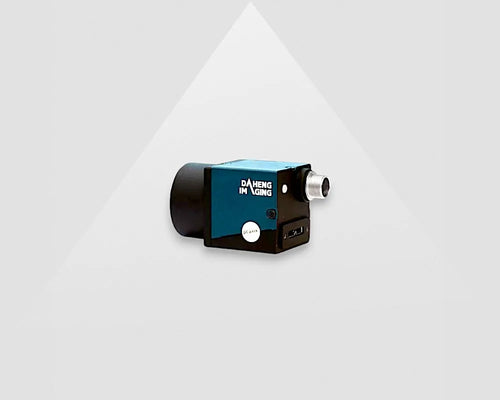

Industrial NIR cameras capture near-infrared light beyond the visible spectrum, helping systems produce clear monochrome images in low-light and controlled-illumination environments. VA Imaging supplies near-infrared cameras for industrial inspection, transportation systems, biometric imaging, agriculture, scientific imaging, and other applications where visible-light cameras may not provide sufficient contrast.
Our United States collection includes USB3 Vision, GigE Vision, and 10GigE Vision cameras with different resolutions, frame rates, and shutter types. VA Imaging Inc. supports United States customers from our office in Charlotte, North Carolina. Our team can help evaluate the camera, lens, lighting, optical filter, cabling, and software environment.


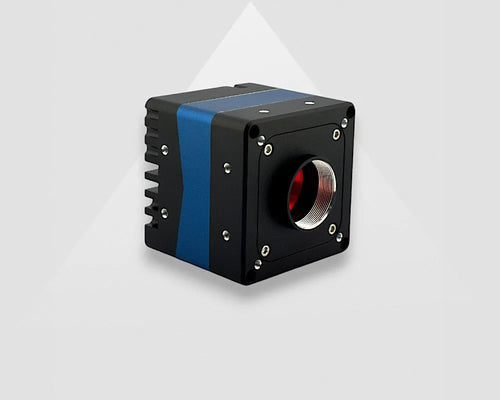
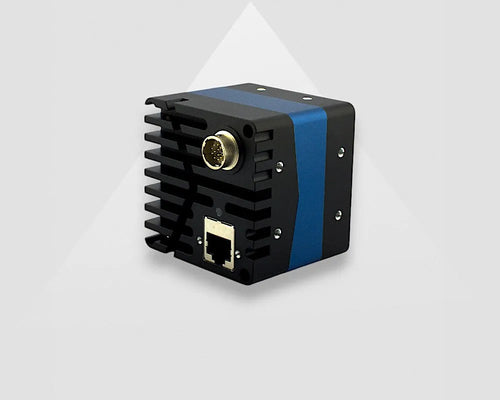


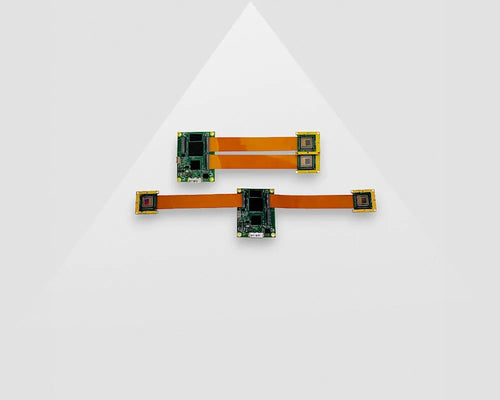
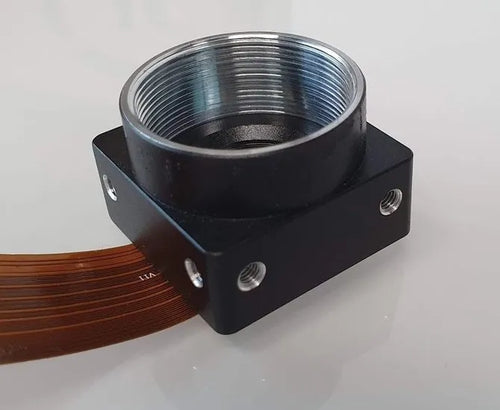


An NIR camera may be suitable when the feature you need to inspect becomes more visible under near-infrared illumination than under visible light.
Consider an industrial NIR camera when a standard monochrome camera has insufficient sensitivity, the system must operate with little visible illumination, materials show useful NIR reflectivity differences, or controlled NIR lighting can provide more consistent contrast.
Another technology may be more suitable when temperature must be measured, visible color is essential, or the required wavelengths exceed silicon sensor response. Testing the target with the intended camera, wavelength, lens, lighting, exposure, and filter is the best way to confirm suitability.
An NIR camera is an imaging camera with increased sensitivity in the near-infrared portion of the electromagnetic spectrum. Near-infrared light lies directly beyond visible red light and cannot be seen by the human eye.
Unlike a standard color camera, an industrial NIR camera is selected for sensitivity and contrast rather than visible-color reproduction. It can reveal differences in reflectivity, surface condition, or material composition that may be difficult to distinguish under visible illumination.
The cameras in this collection are intended for near-infrared imaging commonly performed around 800 nm to 1000 nm. Exact response differs by sensor, so the spectral-response curve should always be checked at the wavelength used in the application.
Quantum efficiency, or QE, describes how effectively an image sensor converts incoming photons into a measurable electrical signal. QE changes with wavelength, so strong visible-light performance does not automatically mean strong sensitivity at 850 nm or 940 nm.
When comparing NIR cameras, review the sensor’s spectral-response or QE graph at the illumination wavelength. Compare sensors at the same wavelength rather than comparing only peak sensitivity.
Exposure, aperture, lighting intensity, working distance, and filter transmission also affect the image. A high megapixel count alone does not indicate strong NIR performance. Resolution determines spatial detail, while the spectral-response curve shows how effectively the sensor detects the selected wavelength.
Key advantages include increased sensitivity at selected near-infrared wavelengths, improved material contrast, imaging without visible illumination, high-resolution CMOS options, and compatibility with common industrial interfaces.
Important considerations include:
The correct industrial NIR camera depends on the feature, movement in the scene, and integration requirements.
First, confirm the intended NIR wavelength and check the sensor-response curve at that wavelength.
Next, match the resolution to the field of view and smallest feature that must be detected. Higher resolution increases image detail but also increases bandwidth, processing, storage, and optical requirements.
Choose shutter type and frame rate according to movement. A global shutter is generally preferred for moving objects, conveyor systems, traffic imaging, and synchronized inspection. A rolling shutter can suit stationary or slower-moving subjects.
Select the interface according to bandwidth and cable requirements. USB3 Vision is practical for high data rates over shorter direct connections. GigE Vision supports network integration and longer cable runs. 10GigE Vision provides additional bandwidth for demanding high-resolution or higher-speed systems.
Finally, confirm sensor size, lens mount, working distance, field of view, lighting angle, and filter selection. A suitable camera can still produce poor results when paired with the wrong optics or illumination.
Controlled NIR lighting creates more repeatable illumination and reduces dependence on changing ambient light. Common wavelengths include 850 nm and 940 nm. Match the wavelength to sensor sensitivity, target reflectivity, working distance, exposure time, and filter transmission.
An IR-corrected lens can help maintain sharp focus across the required wavelength range. This is especially important when a system operates under both visible and NIR illumination because the focal position can shift.
Bandpass filters transmit a selected wavelength range while blocking light outside that band. Longpass filters transmit wavelengths above a specified cutoff. These filters can reduce visible ambient light, isolate the NIR illumination wavelength, and improve image contrast.
NIR cameras detect near-infrared light reflected by the target. They are used for low-light imaging, active NIR illumination, machine vision inspection, and material reflectivity differences.
Thermal cameras detect infrared energy emitted by an object and are selected for temperature differences, heat patterns, and thermal monitoring.
SWIR cameras detect wavelengths beyond the typical response range of silicon-based NIR sensors. They are selected when important material properties or spectral contrast cannot be captured effectively with conventional NIR cameras
VA Imaging Inc. supports machine vision projects across the United States from our office in Charlotte, North Carolina.
Our team can help evaluate the NIR camera, sensor response, resolution, frame rate, shutter type, interface, lens, lighting, optical filter, cabling, software, and documentation required for the application.
The goal is to select a complete imaging system rather than choosing the camera as an isolated component. Compare the NIR cameras in this collection or contact our Charlotte machine vision team for application-specific support.
I am absolutely thrilled with the MER2-160-227U3M camera I purchased from VA-Imaging. The camera exceeds my expectations in every way. The image quality is sharp and clear, even with fast movements. Installation was straightforward. VA-Imaging's customer service was also outstanding. They were very helpful in answering my questions and delivered the camera quickly and securely.
The cameras are a great value for money and the lenses also. The software is outdated and needs refreshing. It took me considerable amount of time to discover how to access the camera features.
Its a pleasure to contact with the sales department. They are very polite and always ready to help. Our orders are always delivered on time and the communication is easy and simple. High quality products.
We initially explored several embedded vision camera and USB3 camera options for our application. Our main priorities were compact dimensions and keeping the required software development to a minimum. We selected a VEN-161 boardlevel camera. It was easy to integrate and USB3 Vision interface allowed our software team to get started quickly. The sales guy was very helpful with selecting the hardware for us. We are happy that we selected the USB3 board-level camera instead of a Mipi embedded vision camera as we didn't require now the additional driver development.
It was easy and quick process from ordering to receiving. One personal message from the team is making it even better. Thanks
In the commercial phase we had maximum support and delivery times were respected. The material is quite good with low and competitive costs.
Most common questions are already answered on our FAQ page. Questions about delivery times, warranty, loan, returns, longevity, manuals etc.
Image processing software captures the images from an industrial camera and performs complex image processing tasks like segmentation, detection, code and text reading.
We share our machine vision knowledge in our knowledge center. Find tutorials how to connect cameras, install software & program I/O.
Check how our customers use our industrial cameras, lenses and lighting in their application
Ask our machine vision experts! We answer rapidly and think along with your imaging project.
The download page provides access to product documentation, software, drivers, manuals and technical resources for industrial cameras and machine vision components.